
18 September 2026 - 8th November 2026
Runes
Chris Dyson
Chris Dyson
Born in Perth in 1952, Dyson moved to Melbourne with his parents at the age of seven and recalls loving art in primary school. As a teen, his high school didn’t offer art; however, Dyson lived in a caravan out the back of his parents’ house, which he painted with poster paints in psychedelia, inspired by Jimi Hendrix album covers. His path towards art was encouraged further when his mum gifted him a set of oil paints.
At the age of twenty-six, Dyson came across an advertisement for lessons in the city with an artist named Erica Huppert. He continued to paint, mainly by himself at home, but was more actively involved in the music scene during this time. This included stints with iconic Melbourne bands from the 1970s, including alternative feminist band Stiletto, and High Rise Bombers—Paul Kelly’s first band upon moving to Melbourne.
He had friends who had been to art school, and so he picked their brains. He applied for a number of art schools and got knocked back, but then finally got into the VCA [Victorian College of the Arts]. That is when he stopped playing music for a while and just really enjoyed the three years he spent studying there.
Painting remained a prominent focus, and Dyson went on to teach at the VCA as a lecturer until 1998. It was during his masters at Monash University from 1995-96 that Dyson started incorporating elements of popular culture and Islamic art into his work. This precipitated a fascination with the decorative elements of ecclesiastical art throughout art history, from Byzantine to Renaissance art, and he cites his Catholicism as a major touchstone in his approach to art and life.
With the 1990s came the height of postmodernism and conceptual art, but Dyson says he didn’t vibe with it, which made it hard to get shows. After living in a shopfront in west Footscray for six years, Dyson was evicted due to its commercial zoning.
From there he found himself moving further and further out of the city, as property prices soared, until he found himself in Stuart Mill.


Sheep & Dreams
Stephen Mackenzie

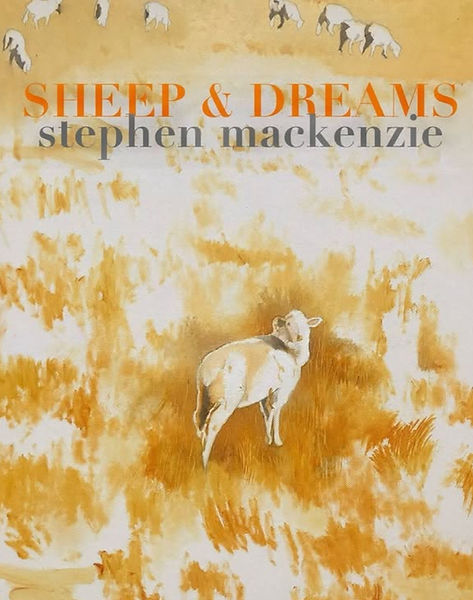
Stephen MacKenzie
Art and design have always been central to Stephen MacKenzie’s life. As a secondary school student he achieved the highest mark in Victoria for graphic design before going on to study design and visual communication at RMIT. After college, he spent 17 years working successfully as an art director in London before returning to Australia.
MacKenzie has developed a distinctive painting practice encompassing both highly detailed floral works and more conceptual pieces.
His large scale oil paintings have been featured in curated collections through Bluethumb and Saatchi Art and have attracted collectors both in Australia and internationally.
Among his best known bodies of work is Ephemeral Beauty, a series exploring the fleeting nature of beauty, from moments of extraordinary colour and abundance through to the beginnings of decay.
Drawing inspiration from the great Dutch floral painters and the dramatic light and darkness of Caravaggio, works in the series include Lilium, Tulips and Peonies and Roses.
MacKenzie has also explored the uncertainty inherent in the creative process.
His Doubt series examines the self questioning, contradiction and vulnerability that can accompany making art, demonstrating a practice that extends beyond traditional still life into ideas about creativity itself.
Earth & Fire
Christine Baines
Christine Baines
Christine Baines is an artist and retired art teacher based on a rural property near Elmhurst where she has a studio.
She has been exploring mosaics for 20 years, working with glass, stone and found objects.
She has exhibited in galleries in Castlemaine, Avoca and the Ararat Art Gallery.
She has studied traditional mosaic making in Italy: in particular Ravenna and Spilimbergo.
She is particularly interested in using traditional techniques and using these to make contemporary mosaics which reinterpret and invigorate the art form.
Christine’s property, where she lives and works, was profoundly impacted by the Bayindeen bushfire in February 2024.
Some of the mosaic works are a response to the impact the fire had on her property and the surrounding forest and farmland.
Other works explore traditional mosaic techniques and materials and how they can be combined with found objects.

